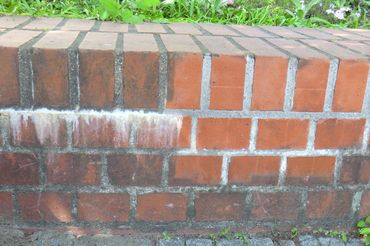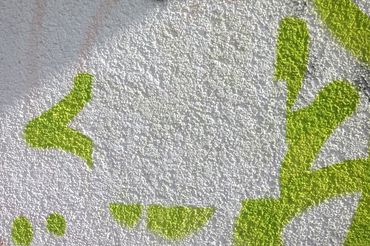

User report from company Pyrexx
The company Pyrexx GmbH has been successfully using our cleaning machine, the Tornado ACS, in facade cleaning since 2018. Together with a journalist, a user report was created, which we would like to present to you here.
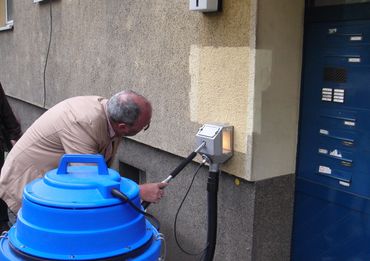
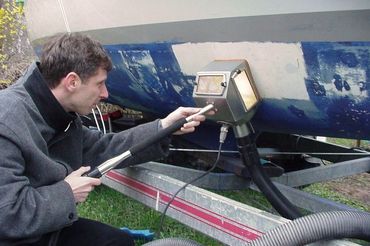
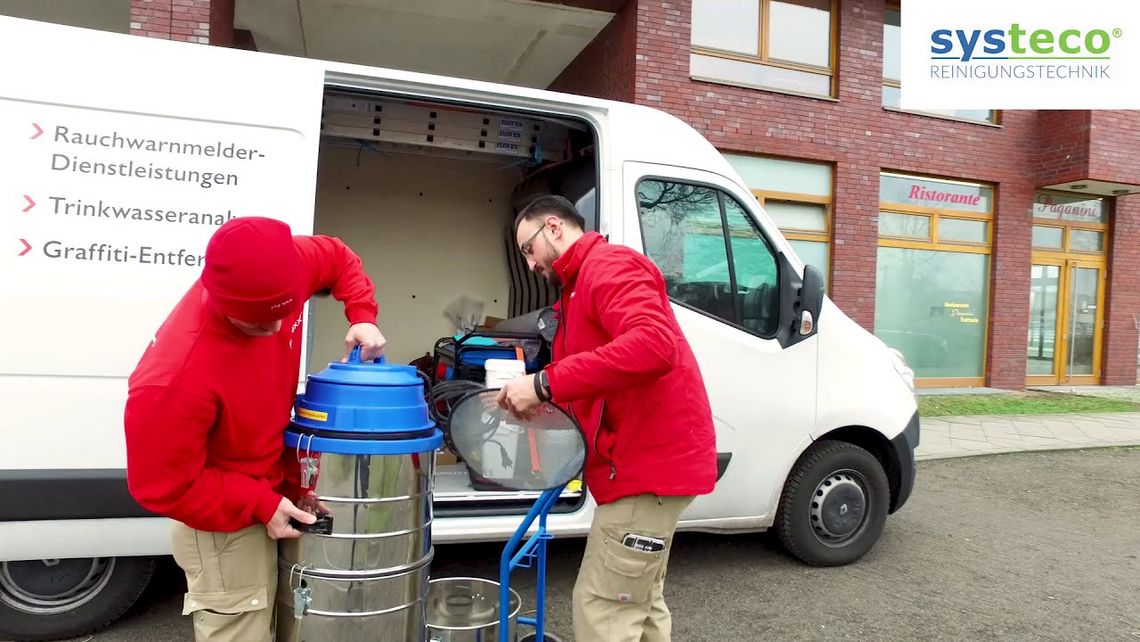
When handling the Tornado ACS cleaning technology, it is generally not necessary to wear gloves. However, in this application it was very cold, so the employees wear gloves, as shown in the photos.
Removal of graffiti fast and eco-friendly
How can graffiti be removed quickly and safely? How can facades and other surfaces be cleaned of dirt using environmentally friendly methods? These questions move many decision-makers. Pyrexx GmbH, headquartered in Berlin, has established itself in the growing market as a successful service provider.
The Tornado ACS cleaning machines from systeco GmbH are the decisive basis for this success. The Berlin-based company holds the patent for the mobile vacuum blasting process. Facades, stair treads, exposed concrete building elements, tiles in swimming pools and other surfaces are cleaned quickly, gently and in an environmentally friendly manner. Pyrexx employees are in use throughout Germany with the Tornado ACS.

Not all graffiti is the same
Graffiti is an expensive annoyance for housing associations and municipalities. If it is anti-constitutional graffiti, it must be removed within 24 hours according to the law. Time is also pressing otherwise, because a clean, well-kept place to live is of high relevance.
There are various methods of removing smearings. Which one is used depends, among other things, on the size of the contamination, the material it was applied to and its condition. The weather also plays a role.
In the meantime, various cleaning methods have become established in the industry in addition to the vacuum-blasting method. "Facades can be cleaned with chemicals, the hot water high-pressure process, the sandblasting process and with dry ice blasting," says Frank Stotz, naming some of the common ones. However, the wrong method can cause a lot of damage, the expert warns. If, for example, the high-pressure water method is used on a composite thermal insulation system, water can run behind the insulation. Under certain circumstances, bulges and mould may form. With other surfaces, there is the threat of other problems: "If you work on sandstone with a sandblasting process, you remove too much of the surface," says Frank Stotz.

Cleaning of monuments
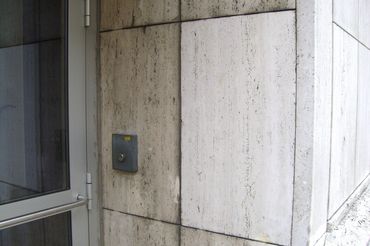
The regulations for the protection of historical monuments apply to architectural monuments. Removing soiling is particularly difficult because the surface must not be attacked. The authorities must approve the respective cleaning procedure. The technology of systeco GmbH is an option for this, as with the Tornado ACS only the paint layer is removed and the substrate is protected.
The cleaning equipment achieves very good results on clinker and exposed concrete. "In the future, we will get even bigger orders there," says Gabor Jakowski.
The equipment can also be used in heavily frequented areas without having to block off traffic beforehand. Passers-by, cyclists and car drivers are not affected. The staff can also work without special protective clothing. Thus, the units meet the highest standards of economic efficiency and environmental compatibility.

Successful service provider in the housing industry
Pyrexx GmbH was founded in 2005 as the first specialist service provider for smoke detectors in Germany. Initially, the company had two employees. It now employs 280 permanent staff and cooperates with the largest housing associations. It is one of three manufacturers of smoke detectors in Europe. The employees handle several thousand appointments per day.
Later, the business field of drinking water analysis was added. Pyrexx employees check the water for legionella, among other things. Recently, the company has also started offering the digitalisation of housing stock. Furthermore, the company offers the removal of graffiti and other dirt from facades. Pyrexx is also making rapid progress in this area. "Based on a photo of the contamination that the customer sends us, we first estimate the costs," explains Sales Manager Gabor Jankowski. "On site, we make a measurement and only charge for the square metres that we actually cleaned." His colleague, Sales Manager Frank Stotz, adds: "In the end, this is cheaper for the customer." He emphasises that Pyrexx employees only remove smearings, not graffiti artwork.

Vacuum blasting method in use
Pyrexx GmbH has found the right method for them: "For most surfaces, we use the Tornado ACS cleaning devices from systeco," says Jankowski. "Joints can also be cleaned excellently with it." Different granulates are used in this process. The machines apply the selected abrasives to the surface to be cleaned. The paint particles dissolve and are separated from the granulate by a cyclone. This can then be used again to remove the paint.
Neither paint residues nor solvents end up in the drain, so that the environment is relieved. Collection facilities for the waste water are not necessary. "The closed circuit is the big advantage of this unit," says Stotz. "With systeco you work really cleanly." His colleague adds, "Unlike the other processes, you don't leave any waste behind."
The process also has fast set-up times. The machines can also be used in frosty conditions. The chemical process in particular is not suitable for use in sub-zero temperatures. The Tornado ACS has great advantages for cleaning small areas of, for example, three to four square metres, even in the interior.

This brilliant cleaning technology especially suits...